How Can Behaviors Increase the Reproductive Success of Animals? List Two Behaviors That Animals Use.
Why do animals help others at the potential cost of their own survival and reproduction?
Social beliefs consists of a set of interactions among individuals of the same species. A wide range of sociality occurs among animals. Some animals rarely if ever interact with i another, even when it comes to issues of parental care. Examples of relatively asocial animals include mosquitoes and polar bears. Highly social organisms live together in big groups, and often cooperate to deport many tasks. Examples of social groups include packs of wolves and schools of fish (Effigy 1). The most highly social animals form tightly knit colonies and include all ants and termites, some bees and wasps, and a few other organisms.
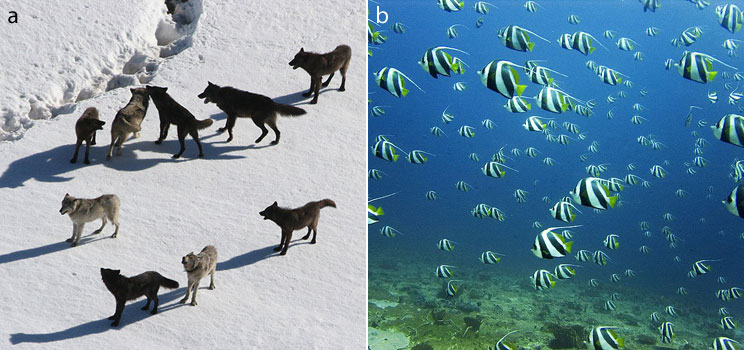
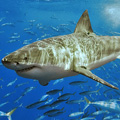
Figure 1: Social groups which have formed to ameliorate the probability of survival and reproduction of individual members: pack of wolves (a) and schoolhouse of fish (b)
Social Behavior is Adaptive
Many social behaviors of animals are adaptive, meaning that being social ultimately increases an creature'due south fitness — its lifetime reproductive success. One example of how social behavior is adaptive is aggregation against predators. This concept applies to caterpillars feeding together on a leaf, a herd of wildebeest, schools of fish, and flocks of birds.
A mural filled with solitary wildebeest will offer easy pickings for large predators such as lions (Figure ii). If the wildebeests gather into a single group, so the risk of any single individual being eaten is reduced. In the circumstance of an assault by a predator, the odds of one individual being targeted are 100% for solitary individuals, 1% in a group of 100, and 0.ane% in a group of 1000. Wildebeests practice suffer social costs from aggregating in groups — grazing sites may not provide acceptable food for every individual in the grouping, for case. However, it is not difficult to imagine that the costs of social aggregation are much smaller than the benefits of the defense against predation. This is a unproblematic example of how the costs and benefits of social beliefs may evolve and be maintained.
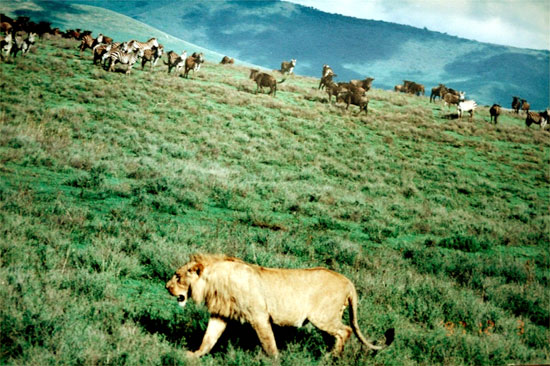
Figure 2: Wildebeests gathered into groups are more protected from predators than any solitary wildebeest.
Living in groups involves a residual of conflict and cooperation, which is mediated by the costs and benefits associated with living socially. When the benefits of living socially exceed the costs and risks of social life, scientists predict that social cooperation will be favored.
Altruism
The benefits of social life typically occur when 1 individual is the benefactor of an act of altruism. An altruistic human action is one that increases the welfare of some other individual at an actual or potential cost of the individual who performs the act.
An example of altruism comes from ground squirrels, who may warn other members of their grouping virtually a predatory militarist overhead. This brings the hawk'southward attention to the individual giving the alert telephone call. This risky behavior benefits other individuals in the squirrel's group. Other examples of donating beliefs include sharing nesting space and helping to enhance offspring of an unrelated individual.
The benefit of an donating beliefs is ultimately measured in its upshot on an beast'southward lifetime reproductive success. Evolutionary biologists and animal behaviorists accept sought to identify the mechanisms that can explicate what some have chosen the "problem of altruism." Natural choice operates against individuals who reduce their ain fettle. Altruism by definition decreases the fettle of the private, and then how tin can this behavior persist? The solution to the "trouble" of altruism comes from decades of inquiry into genetics and creature behavior, which has taught us that altruism is a powerful demonstration of natural choice at piece of work.
Reciprocity
Vampire bats (Effigy 3) returning from an unsuccessful foraging bout will beg to share food from successful individuals. It is most directly in the interest of the solicited bat to continue its own food, equally it requires the nutrients to survive and reproduce, and giving up office of its repast is in fact altruistic. Thus in both ecological and evolutionary terms, other members of this bat'south ain species are its greatest competitors.
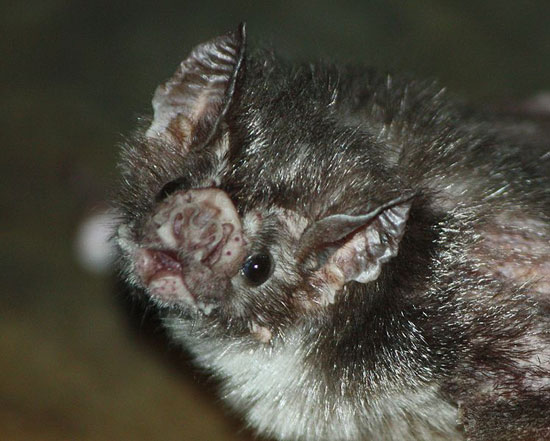
Effigy iii: A vampire bat, an excellent model system to test theories regarding the altruistic sharing of nutrient
And then why would a vampire bat share its meal of blood? The respond is reciprocity. In the early 1980s, graduate student and researcher Gerald Wilkinson conducted a serial of experiments to demonstrate that vampire bats in Costa Rica often shared blood with other bats sharing their roosts. He found, notwithstanding, that bats did not share their meals with all other bats equally.
Why would bats not share food equally? Based on long-term measurements of bat movements amongst roosts, Wilkinson found that some bats were more probable to collaborate with certain individuals more than others. Bats were far more likely to share blood with bats they were more than likely to encounter in the future. In other words, when there was a greater opportunity for reciprocation, the bats were more likely to share their meals. Bats would not share blood meals with other bats if there was little hazard that the other private would exist able to render the favor.
Reciprocity enables the beingness of altruism because — in the long term — the benefits of altruism tin can outweigh the costs of altruism. In this particular example, the relative cost of sharing nutrient, when available, is less than the potential future do good of receiving food when hungry.
Kin Selection
Vampire bats share food not only because of the anticipation of reciprocation. They are far more likely to share blood meals with their relatives. After taking into account the potential for reciprocity, vampire bats are more inclined to share their blood meals with kin than with unrelated individuals. Using genetic analyses, researchers can summate the relatedness amongst individuals. Bats that are more closely related are more likely to share resource.
Why are relatives more than probable to be the recipients of donating acts than non-relatives? Individuals are far more than likely perform altruistic acts for siblings than for nephews, and even less likely for third cousins. The mechanism behind the effect of relatedness on altruism is kin choice. Natural selection reflects how an private passes on copies of their own genes through survival and reproduction, simply kin selection reflects how copies of an individual's genes are passed down through the survival and reproduction of their relatives. Just as the principle of natural selection predicts that an individual will act to maximize their ain fitness, the principle of kin pick predicts that an individual will act altruistically to maximize the fitness of its relatives.
In that location are limits to altruism. An individual'due south direct fitness is measured by copies of her own genes passed on to children, grandchildren, and so on, whereas indirect fitness is the measure out of copies of her genes passed on through her non-descendant relatives such as cousins, nieces, nephews, and siblings. Selection volition favor an donating act if the benefit of the act (in terms of indirect fitness) exceeds the toll of the act (in terms of direct fettle). When individuals are more closely related, they accept a greater relatedness (r) and altruism is more likely to occur. Relatedness is measured on a scale from 0–1 considering it reflects the proportion of genes that are shared by ii individuals. Nil indicates no relation amid individuals. The coefficient r every bit measured in other pairs includes full siblings: 0.v; parent-offspring: 0.five; grandparent-grandchild: 0.25; cousins: 0.125.
In the 1960s, W. D. Hamilton formulated what is at present commonly known as Hamilton'southward dominion, in which relatedness is shown to moderate the probability that altruistic acts volition occur. According to Hamilton's dominion, altruism is favored when the benefits (B) of the donating act to the recipient, multiplied by the relatedness (r) to the player, exceed the costs (C) to the role player; this is expressed mathematically as rB > C. In addition to vampire bats, other species such every bit basis squirrels, paper wasps, and wild turkeys follow Hamilton'due south rule.
Eusociality
The development of social behavior at its most intimate and complex degree is establish in eusocial animals. Eusocial species live in colonies. Only a relatively small fraction of the animals in the colony reproduce; the non-reproductive colony members provide resources, defense, and collective care of the young. The list of known eusocial animals includes ants, termites, some wasps, some bees, a small number of aphid and thrip species, two species of mammal (the naked mole rat and the Damaraland mole rat), and multiple species of reef-dwelling house shrimp.
How can selection produce an organism that has no chance of reproducing independently, whose fitness is entirely invested into colony mates? In other words, how can animals have no direct fitness and only indirect fettle? Individuals in colonies are ordinarily related to one another, and relatedness tin can even be greater than 0.5 as a effect of the unique genetics of some groups of insects or inbreeding (mating between close relatives). Hamilton's rule and kin selection provide at least a partial caption for the development of eusociality.
An ecological explanation for the evolution of eusociality is that colonies often produce a very large number of offspring, such that even when relatedness is low the indirect fitness of the non-reproductive workers may be greater than if they had the capacity to reproduce independently. In eusocial animals, the loftier productivity resulting from communal life and the efficient segmentation of labor among workers takes place in an environment which is usually well defended confronting natural enemies (Figure iv). In nearly all eusocial species, colonies are protected through structural means (such as termite nests in woods, or shrimp in marine sponges), with venom (of wasps, bees, and ants), or by both means.
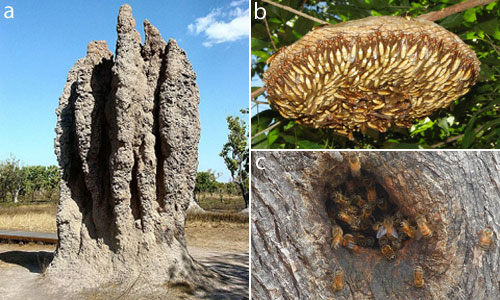
Figure 4: Social insects have well protected or dedicated nests, including termites (a), wasps (b), and bees (c).
Summary
Social and altruistic behaviors crave a wide view of Darwinian fitness and an understanding that animals can perform behaviors that are responsive to brusque-term and long-term consequences for their fitness. Past conducting inquiry into how organisms interact with their environment and how the environment is predictive of their survival and reproductive success, researchers are able to explain how social behavior has evolved via the mechanism of natural selection.
References and Recommended Reading
Hamilton, Westward. D. The genetical development of social behaviour. International Journal of Theoretical Biological science 7, 1-16 (1964).
Sherman, P. W. Nepotism and the evolution of alarm calls. Science 197, 1246-1253 (1977).
Wilkinson, G. S. Reciprocal food sharing in the vampire bat. Nature 308, 181-184 (1984).
This content is currently nether construction.
Topic rooms within Animal Behavior
Close
No topic rooms are there.

- | Lead Editor: Sara Tenney
Source: https://www.nature.com/scitable/knowledge/library/how-does-social-behavior-evolve-13260245/
0 Response to "How Can Behaviors Increase the Reproductive Success of Animals? List Two Behaviors That Animals Use."
Post a Comment