Situation in Which Kinship Is Tracked Through the Mother?s Family.
Descent Principles: Function 1
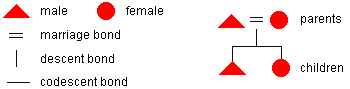
Kinship is reckoned in a number of dissimilar means around the globe, resulting in a variety of types of descent patterns and kin groups. Anthropologists frequently use diagrams to illustrate kinship relationships to make them more understandable. The symbols shown here are ordinarily employed. They may be combined, every bit in the example beneath on the right, to stand for a family unit consisting of a married couple and their children.
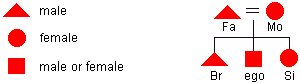
In kinship diagrams, ane individual is usually labeled equally ego
. This is the person to whom all kinship relationships are referred. In the instance beneath on the correct, ego has a brother (Br), sister (Si), male parent (Fa), and mother (Mo). Note too that ego is shown as being gender nonspecific--that is, either male or female.
Unilineal DescentNearly cultures severely limit the range of people through whom descent is traced by using a unilineal
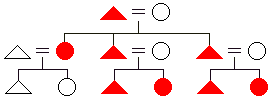
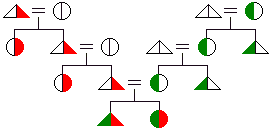
With patrilineal descent , both males and females belong to their father's kin group but not their mother'southward. Still, only males laissez passer on their family identity to their children. A woman'due south children are members of her husband'southward patrilineal line. The ruby-red people in the diagram below are related to each other patrilineally.
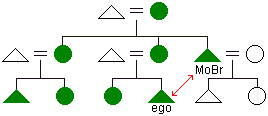
The form of unilineal descent that follows a female line is known every bit matrilineal . When using this design, individuals are relatives if they can trace descent through females to the aforementioned female ancestor. While both male and female children are members of their mother's matrilineal descent grouping, only daughters can pass on the family unit line to their offspring. The green people below are related to each other matrilineally.
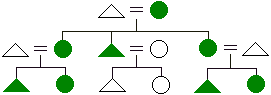
In societies using matrilineal descent, the social relationship between children and their biological father tends to be unlike than near people would expect due to the fact that he is non a member of their matrilineal family. In the case of ego below, the human being who would have the formal responsibilities that European cultures assign to a father would be his female parent's brother (MoBr), since he is the closest elder male kinsmen. Ego'south begetter would have the same kind of responsibilities for his sister's children.
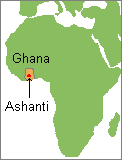
Inheritance patterns for men in matrilineal societies too oftentimes reflect the importance of the mother's brother. For case, in the Ashanti Kingdom of Central Ghana, a rex traditionally passes his title and status on to his sister's son. A king's ain biological son does not inherit the kingship because he is not a member of the ruling matrilineal family group. Women usually inherit status and holding directly from their mothers in matrilineal societies.
Unilineal descent has been found most commonly, but not exclusively, among materially rich foragers, small-scale-scale farmers, and nomadic pastoralists
Cognatic DescentAt least forty% of the societies around the world today trace descent through both the mother's and the male parent'southward ancestors to some degree. They follow one of several nonunilineal or cognatic
When both patrilineal and matrilineal descent principles are combined, the result is the bilineal
Every bit a result, everyone, except siblings
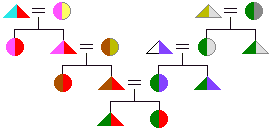
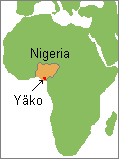
The Y�ko of southeastern Nigeria are an example of a lodge with bilineal descent. Their important portable property, including livestock and money, are inherited matrilineally. Stock-still property, such as farm plots, pass down through the patrilinal line as do rights to trees and other forest products. Information technology is not surprising that they have patrilineally inherited obligations to cooperate in cultivating their fields. Obligations to perform funerals and pay bride price for sons are inherited through the matrilineal line.
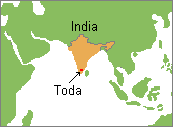
The Toda of southern Bharat likewise follow bilineal descent. Their property is inherited patrilineally and ritualistic privileges related to funerals are inherited matrilineally.
A similarly rare combination of unilineal descent patterns is known equally parallel
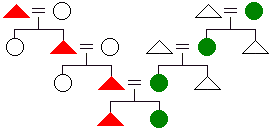
Ambilineal
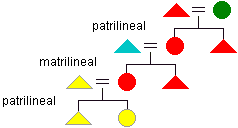
The reason for choosing one side over the other often has to do with the relative importance of each family. In other words, ambilineal descent is flexible in that it allows people to adjust to changing family unit situations. For instance, when a human being marries a adult female from a politically or economically more than of import family, he may agree to permit his children identify with their mother'due south family unit line to heighten their prospects and continuing inside the order.
This page was last updated on Tuesday, June 27, 2006 .
Copyright � 1997-2006 by Dennis O'Neil. All rights reserved.
Illustration credits
Source: https://www2.palomar.edu/anthro/kinship/kinship_2.htm
0 Response to "Situation in Which Kinship Is Tracked Through the Mother?s Family."
Post a Comment